
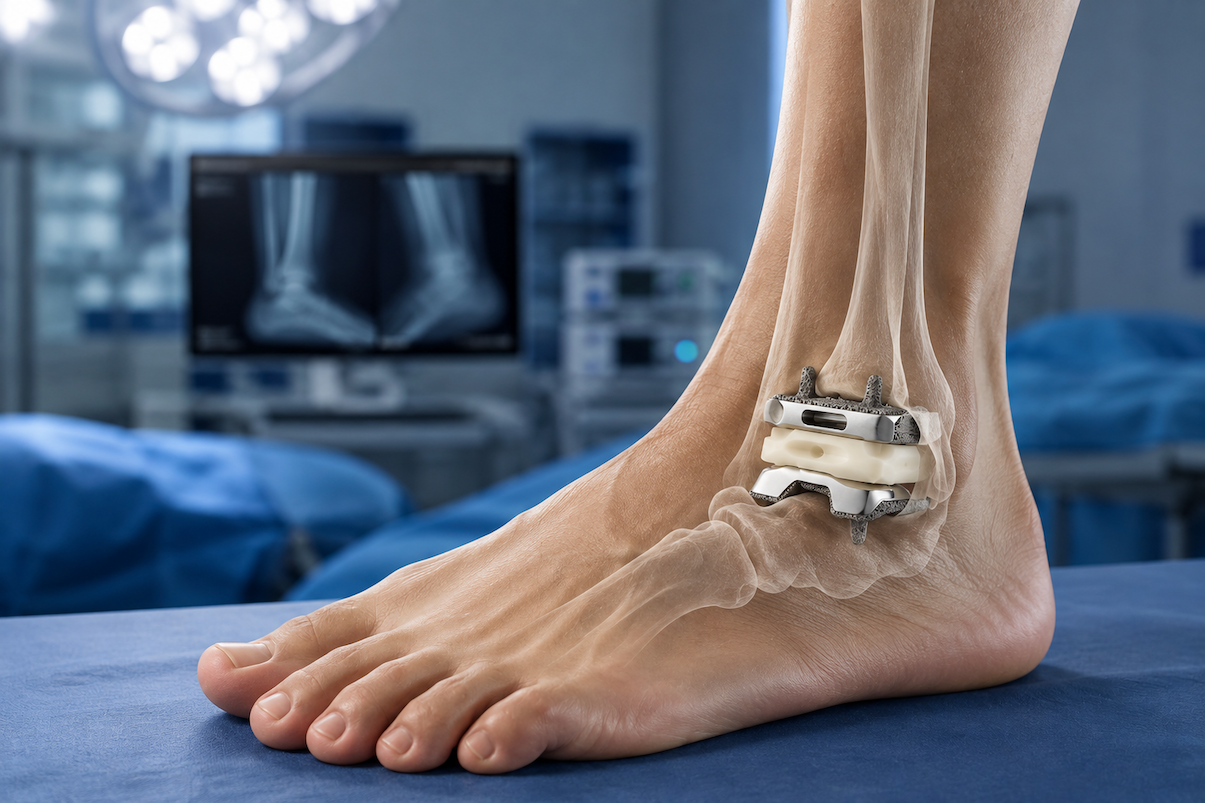


Ankle joint replacement, also known as total ankle replacement, is an established surgical treatment for patients with advanced ankle arthritis. The aim of surgery is primarily to relieve pain while preserving movement at the ankle and allowing patients to return to more comfortable and natural everyday activities.
For patients considering ankle replacement surgery, understanding what happens during the operation and what to expect during recovery can make the treatment journey much easier.
What does ankle replacement surgery involve?
Ankle replacement surgery is performed through an incision at the front of the ankle.
The damaged arthritic surfaces of the ankle joint are carefully removed and replaced with artificial joint components. Accurate positioning and alignment of the replacement are particularly important. During surgery, X-ray imaging is used to help confirm the position of the components and the alignment of the ankle.
The operation is not simply about inserting an artificial joint. Any associated deformity or imbalance around the ankle also needs to be considered. Therefore, additional procedures such as soft-tissue balancing or release of tight structuresmay be performed when necessary to achieve a well-aligned and stable ankle.
Can I walk after an ankle replacement?
In my usual postoperative protocol, patients can generally put weight through the operated ankle from an early stage, using the protection provided after surgery.
However, being allowed to bear weight does not mean immediately returning to normal walking and daily activities. During the first two weeks, I advise patients to spend very little time on their feet and to elevate the leg as much as possible. This is particularly important because excessive activity during this early period can significantly increase swelling.
How painful is ankle replacement surgery?
Most patients find that postoperative pain is manageable.
The majority require regular painkillers mainly during the first few days following surgery, after which the level of pain usually settles considerably.
An important point is that swelling is often one of the main contributors to discomfort after ankle replacement. Careful control of swelling through rest and elevation is therefore an important part of early recovery.
What happens during the first six weeks?
The first two weeks are mainly focused on allowing the wound to heal and controlling swelling.
At approximately two weeks after surgery, the wound is reviewed and the stitches are removed. The patient then normally continues using the protective boot for approximately another four weeks.
Physiotherapy forms an important part of rehabilitation during this period. The programme gradually introduces exercises designed to restore ankle movement and strengthen the muscles and tendons around the ankle.
Recovery should be progressive rather than rushed. The amount of activity is increased according to wound healing, swelling, strength and the progress of the ankle.
When can I return to normal activities?
By around the end of the initial six-week period, patients can gradually begin increasing their everyday activities.
Low-impact exercise is particularly useful during rehabilitation. Activities such as swimming and cycling can normally be introduced as recovery progresses.
Swelling can continue to come and go for quite some time following ankle replacement. This does not necessarily mean that there is a problem with the replacement. The ankle may swell more after increased activity and then settle again with rest and elevation.
When can I return to work?
The answer depends considerably on the type of work involved.
Someone who is able to work from home may sometimes return to work within a week or less, provided they can keep the leg elevated and avoid unnecessary activity.
For patients who need to commute to work, spend significant periods away from home or remain on their feet, approximately six weeks may be required before returning.
Patients should therefore plan their return to work according to both their occupation and how their ankle is progressing rather than relying on a fixed date.
How long does full recovery take?
There is no single point at which every patient can be considered completely recovered.
Daily activities are reintroduced gradually, and strength, confidence and endurance continue to improve over time. One way I describe full recovery to patients is that it is reached when they are going about their normal lives without constantly being aware of, or thinking about, their ankle.
This process takes time. Even after the initial postoperative rehabilitation has been completed, the ankle can continue to improve and swelling can gradually reduce over the following months.
What is the aim of ankle replacement?
The principal goal of ankle replacement is pain relief while retaining movement at the ankle joint.
Successful treatment is not simply determined by the X-ray appearance of the replacement. The ultimate objective is to enable the patient to walk more comfortably, regain independence and return progressively to the everyday activities that ankle arthritis had previously restricted.
Careful preoperative planning, accurate positioning of the replacement, correction of associated deformity and a structured postoperative rehabilitation programme all contribute to achieving the best possible result.